

AI detection has tightened fast in 2026, and if you write, publish, or submit content regularly, you already feel it. Tools like GPTZero, Turnitin, and Originality.ai no longer rely on simple keyword patterns. They analyse sentence rhythm, structural predictability, and how ideas unfold across paragraphs. Even lightly edited AI text now triggers flags if it keeps the same underlying structure.
That shift is why knowing how to make text not AI detectable matters more than ever. This is no longer about swapping a few words or running content through a basic paraphraser. Detectors look for consistency that humans rarely maintain: evenly sized sentences, overly clean grammar, and repeated transitions. When those signals stack up, the content gets marked, regardless of intent.
Writers need safer, more human-like content because detection now affects grades, publishing approvals, SEO visibility, and client trust. The goal is not to misrepresent authorship or bypass rules dishonestly. Ethical rewriting and humanization focus on clarity, originality, and natural expression, not deception.
The tips below explain how to make text not AI detectable by changing structure, tone, and depth in ways detectors actually react to, based on how these systems work today, not how they market themselves.
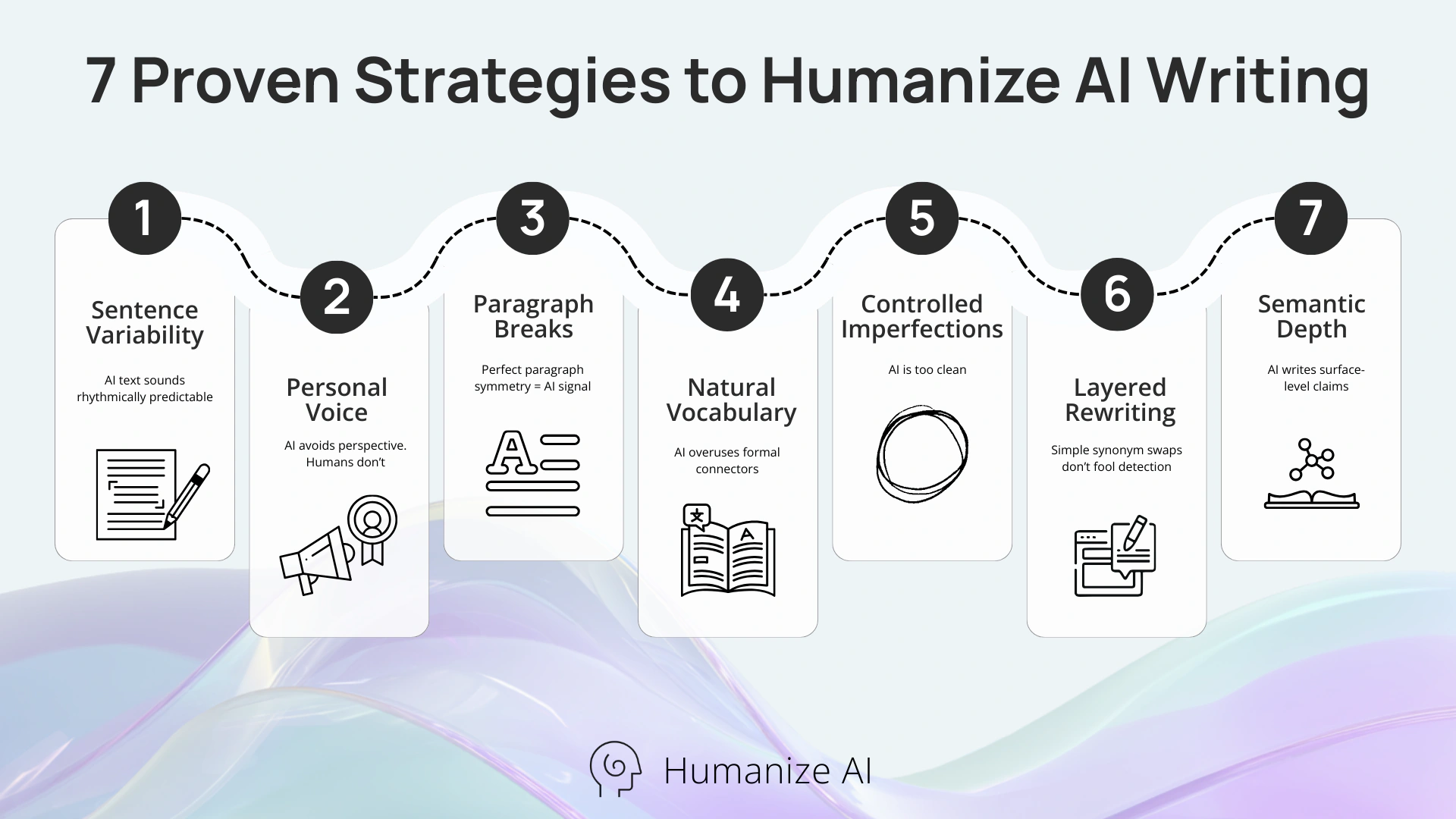
1. Add Human-Like Sentence Variability
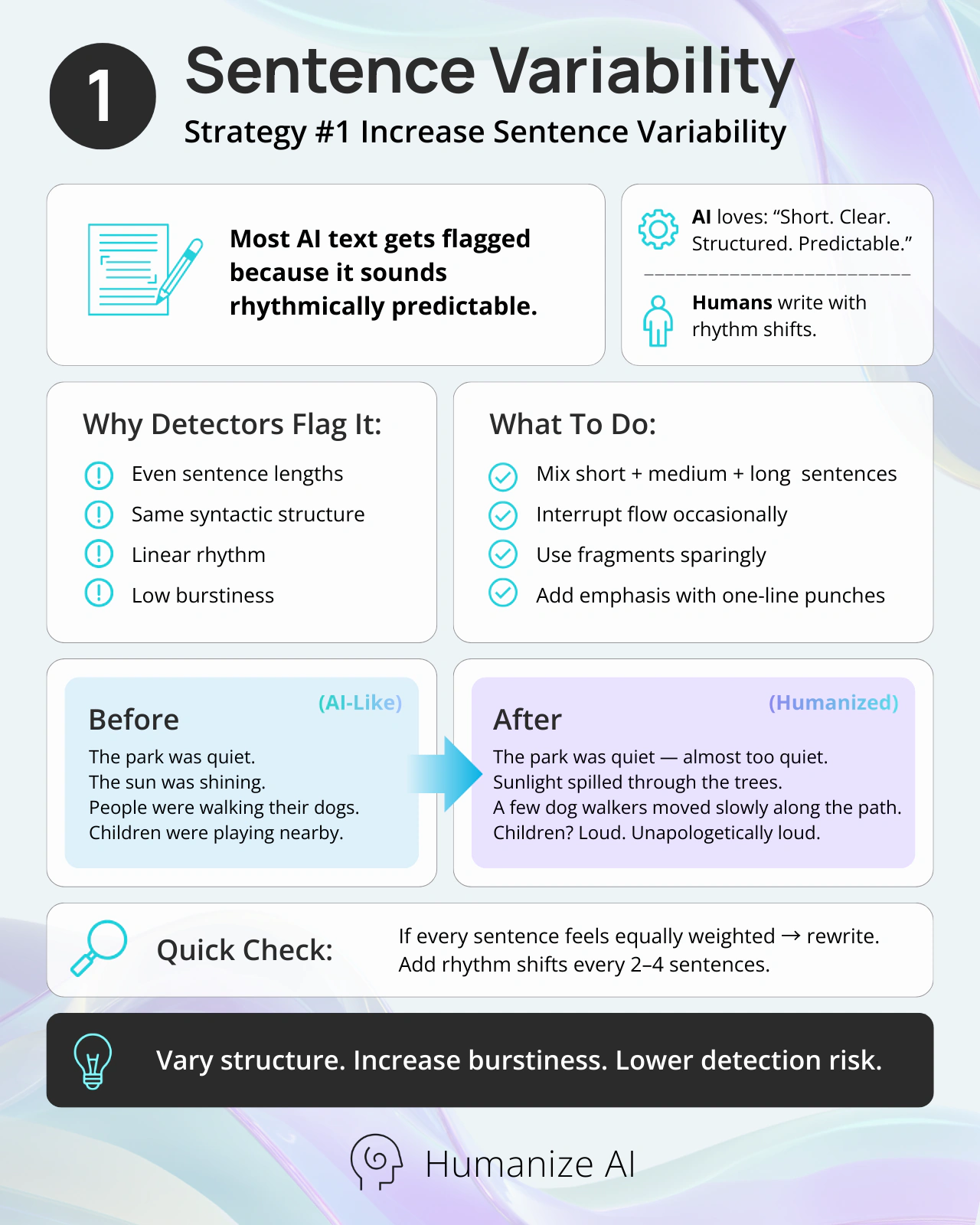
AI detection systems work by measuring statistical regularity, not writing quality. One of the strongest signals they rely on is how predictable sentence structure remains across a passage.
A foundational paper from researchers at the University of Maryland and OpenAI collaborators, published on arXiv, explains that AI-generated text shows lower entropy and higher structural regularity than human writing. In simple terms, machine text tends to repeat similar sentence lengths and syntactic patterns, while human writing varies naturally as ideas develop.
This finding is echoed in OpenAI’s own technical discussions, which acknowledge that large language models optimise for fluency and coherence. That optimisation leads to consistent sentence pacing and smooth transitions, traits that differ from how humans actually write over long stretches of text.
Detection models exploit this difference. They do not need to identify specific words. They score how often sentence length, structure, and transitions repeat. When those patterns stay stable across paragraphs, the probability of AI authorship increases.
That is why synonym swapping fails to make text not AI detectable. Vocabulary changes do not alter the underlying statistical behaviour.
To reduce detection signals, sentence variability must be structural:
- Alternate short, medium, and long sentences intentionally
- Break up evenly paced paragraphs with abrupt emphasis or clarification
- Avoid repeating the same sentence openings or transition formulas
Human writing is uneven by nature. Once your text stops behaving like a statistically balanced system, detection confidence drops. That is the real reason sentence variability matters.
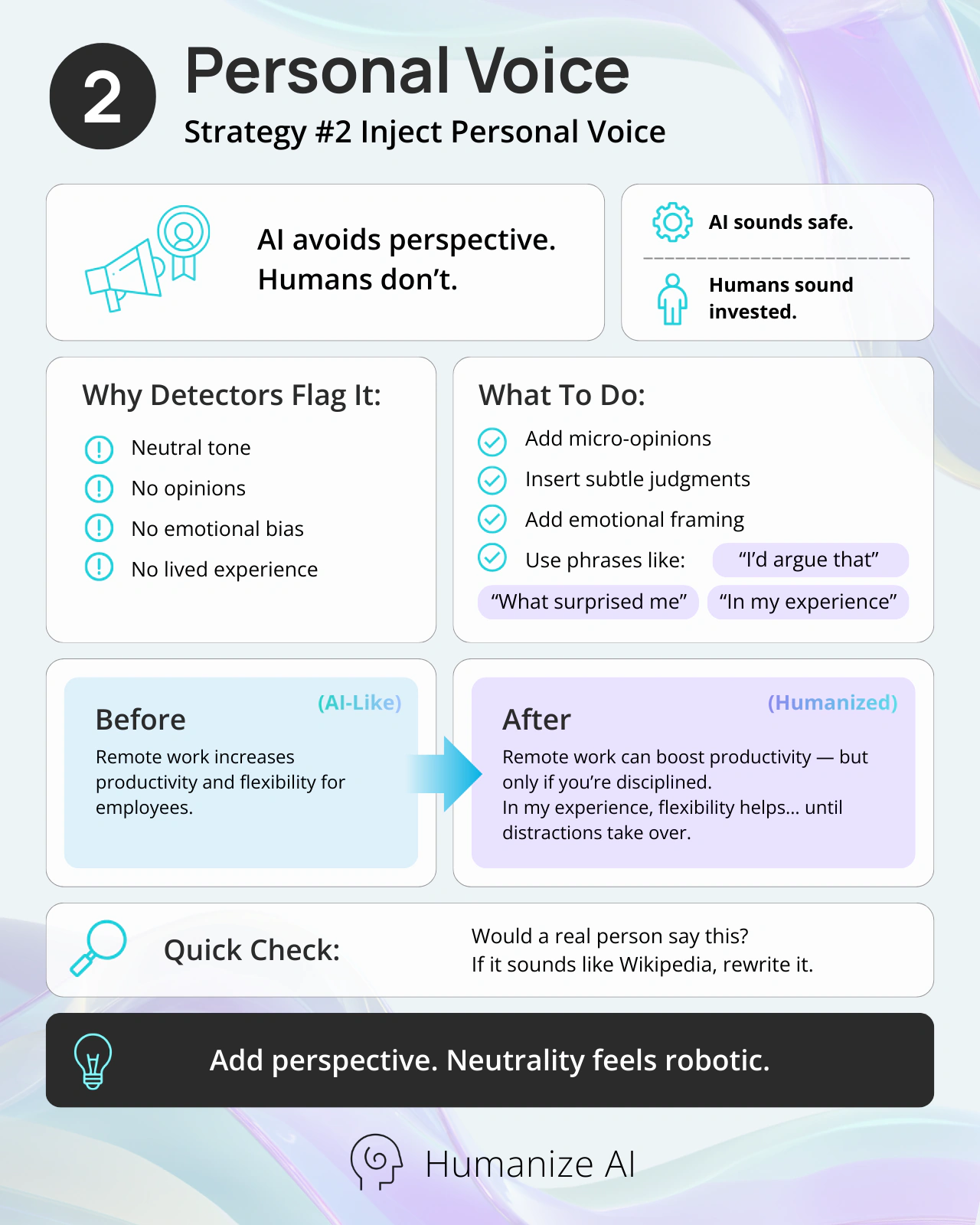
2. Use Personal Voice, Opinions, and Real-World Examples
Why Generic Writing Gets Flagged as AI
AI detectors do not verify whether a human actually wrote the text. They estimate probability based on patterns. When writing avoids personal framing and sticks to neutral, polished language, it can look statistically similar to AI output.
This problem is documented by professional writers themselves. In a widely discussed Reddit thread, a freelance writer explains that original human-written work was flagged with 90% confidence as AI-generated during an SEO review process, despite no AI tools being used. The common factor was clean, impersonal writing produced for clients, not automation.
This shows that avoiding personal voice does not make writing safer. It often does the opposite.
How Personal Context Reduces AI-Likeness
Scribbr’s analysis of AI detection systems confirms that these tools operate on probabilistic signals, not certainty. Their research found that even the best AI detectors reach only 84% accuracy, while free tools perform closer to 68%, which explains why false positives are common in neutral or formulaic writing.
Because detectors cannot prove authorship, they rely on structural cues. Writing that lacks personal perspective tends to follow predictable semantic paths, which increases AI-likeness scores.
Why Opinions and Examples Break Detection Patterns
Yomu explains that modern AI detectors use embeddings, which convert text into numerical vectors to measure semantic coherence. Text that stays abstract and impersonal maintains smooth coherence, making it easier to classify. Personal opinions and real-world examples disrupt that flow by adding subjective emphasis and uneven reasoning that models struggle to predict.
Adding phrases like “in my experience”, “most people working with clients notice”, or referencing a specific situation introduces variability that lowers AI detection confidence.
If you want to avoid ai detection in writing, removing yourself from the text is a mistake. Personal voice is not decoration. It is a structural signal that detectors consistently fail to model accurately.
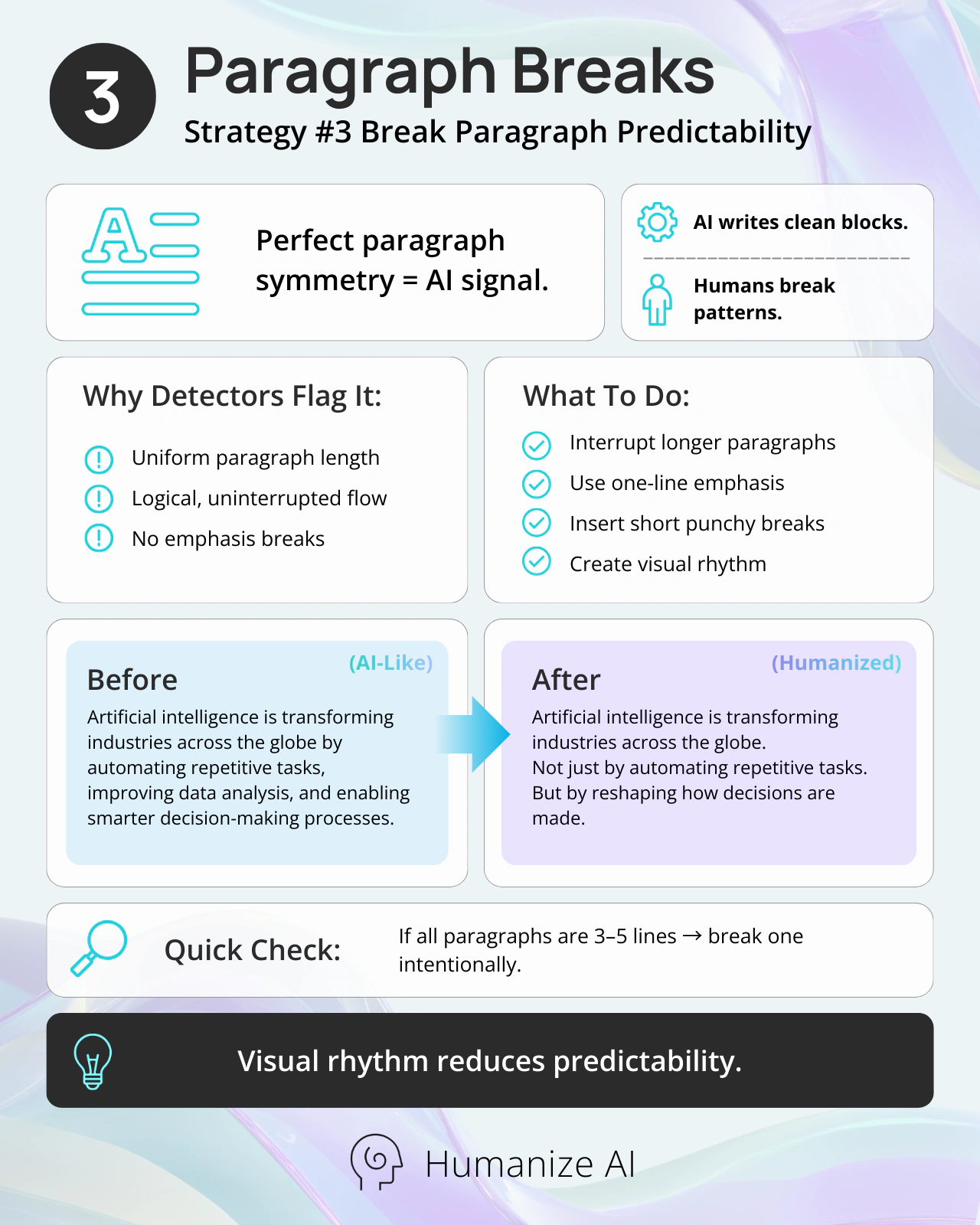
3. Break Predictable Patterns in Paragraphs
Why Paragraph Predictability Triggers AI Detection
AI detectors do not analyse sentences in isolation. They evaluate patterns across entire paragraphs. When multiple paragraphs begin the same way, follow the same logical rhythm, or rely on standard transition phrases, the text becomes statistically predictable.
Benchmarks published in 2025 show that modern detection systems perform best when structure repeats. According to AI detection benchmark analyses, tools consistently score higher confidence when paragraph openings follow formulaic transitions such as “Additionally,” “Moreover,” or “In conclusion.” These phrases appear frequently in AI-generated content because models are trained to optimise coherence and flow.
Large-scale testing using datasets like HATC-2025, which includes over 50,000 human and AI-written samples, confirms this behaviour. Detection accuracy increases when paragraphs maintain uniform structure, even if vocabulary is changed. This is why paraphrased text still gets flagged.
What 2025 Benchmarks Reveal About Structure
Head-to-head evaluations of leading detectors show that structural regularity plays a bigger role than word choice. While tools such as Originality.ai, GPTZero, and Copyleaks vary in precision and recall, none of them perform well when paragraphs become irregular and context-driven.
Academic benchmarks cited in 2025 studies report average detection performance around the high-80% range, with accuracy dropping sharply when paragraph flow becomes uneven or when transitions are unexpected. This supports a consistent finding across research: predictability at paragraph level raises AI-likeness scores.
How to Break Paragraph Patterns Effectively
If your goal is to get rid of AI detection, you need to disrupt structure, not polish it.
Practical ways to do this include:
- Avoid repeating the same transition words across sections
- Start some paragraphs with context, others with contrast, and some with direct statements
- Use rhetorical questions sparingly to interrupt expected flow
- Let paragraphs vary in length instead of maintaining symmetry
Example: Predictable vs. Human Paragraph Flow
Before (predictable):
Additionally, AI detection tools analyse sentence structure. Moreover, they rely on probability models. In conclusion, writers must adjust their style.
After (human-like):
AI detection tools do not read intent. They measure behaviour. So when structure stays neat and predictable, probability rises. That is the problem most writers run into.
The second version breaks transition repetition, alters pacing, and shifts emphasis. The meaning stays intact, but the structure no longer follows a template.
Detection benchmarks consistently show that paragraph-level variation reduces confidence scores, even when content is revised multiple times. This is why breaking predictable paragraph patterns is one of the most reliable ways to reduce AI-likeness without damaging clarity.
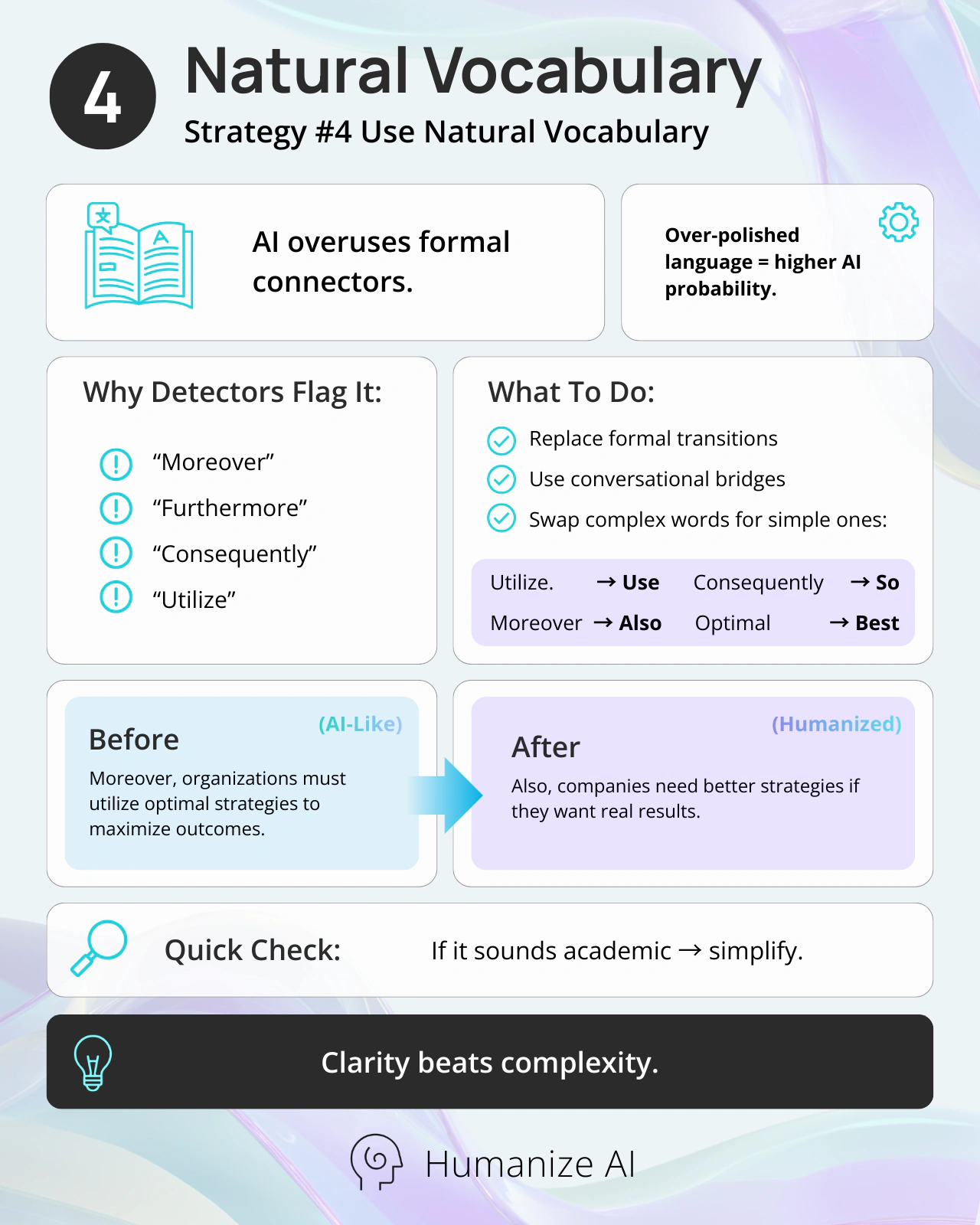
4. Humanize Vocabulary and Reduce Over-Optimization
Why “Perfect” Vocabulary Raises AI Flags
AI-generated text often sounds correct, but that correctness is part of the problem. Detection systems are trained to notice over-optimized language. That includes polished vocabulary, evenly weighted synonyms, and grammar that never slips. Human writing does not behave that way at scale.
Google’s Search Quality Evaluator Guidelines make this distinction clear. They emphasise that content written primarily to satisfy systems rather than people tends to show unnatural wording choices and excessive optimisation, which reduces perceived quality even when grammar is flawless.
Overly formal words, textbook synonyms, and mechanical phrasing increase predictability. That predictability is measurable.
How Clean Grammar and Synonym Swapping Backfire
AI detectors do not reward linguistic perfection. They penalise it. Research summarised by Scribbr explains that detectors rely on probability models rather than meaning. Text with extremely consistent grammar and vocabulary produces low entropy signals, which increases AI-likeness scores instead of lowering them. This is why rewriting tools that “clean up” language often make detection worse, not better.
Research from the Nielsen Norman Group consistently shows that users understand and engage with content better when vocabulary is plain, direct, and conversational, rather than formal or overly complex. Their usability studies demonstrate that readers process simple wording faster and are more likely to trust and retain information written in everyday language.
What to Change to Bypass AI Detection
If you want to bypass AI detection, vocabulary choices must feel natural, not engineered.
Effective adjustments include:
- Replacing stiff, academic terms with everyday equivalents
- Avoiding stacked synonyms that sound “balanced” rather than intentional
- Allowing mild repetition instead of forced variation
- Preferring clarity over elegance
For example, replacing “utilise” with “use”, or “facilitate” with “help”, lowers optimisation without lowering quality.
Human writing is not maximally efficient. It is uneven, occasionally redundant, and context-driven. Once vocabulary stops sounding like it was selected to impress an algorithm, detection confidence drops.
Reducing over-optimization is not about lowering standards. It is about restoring human imperfection, which remains one of the hardest signals for detection systems to model accurately.
Surface Rewrite vs Structural Rewrite
| Rewrite Type | What Changes | Detection Risk |
| Word swapping | Vocabulary only | High |
| Grammar polishing | Syntax cleanup | High |
| Paraphrasing tools | Sentence wording | Medium |
| Structural rewriting | Sentence flow + pacing | Lower |
| Human-edited rewrite | Structure + reasoning | Lowest |
5. Add Controlled Imperfections
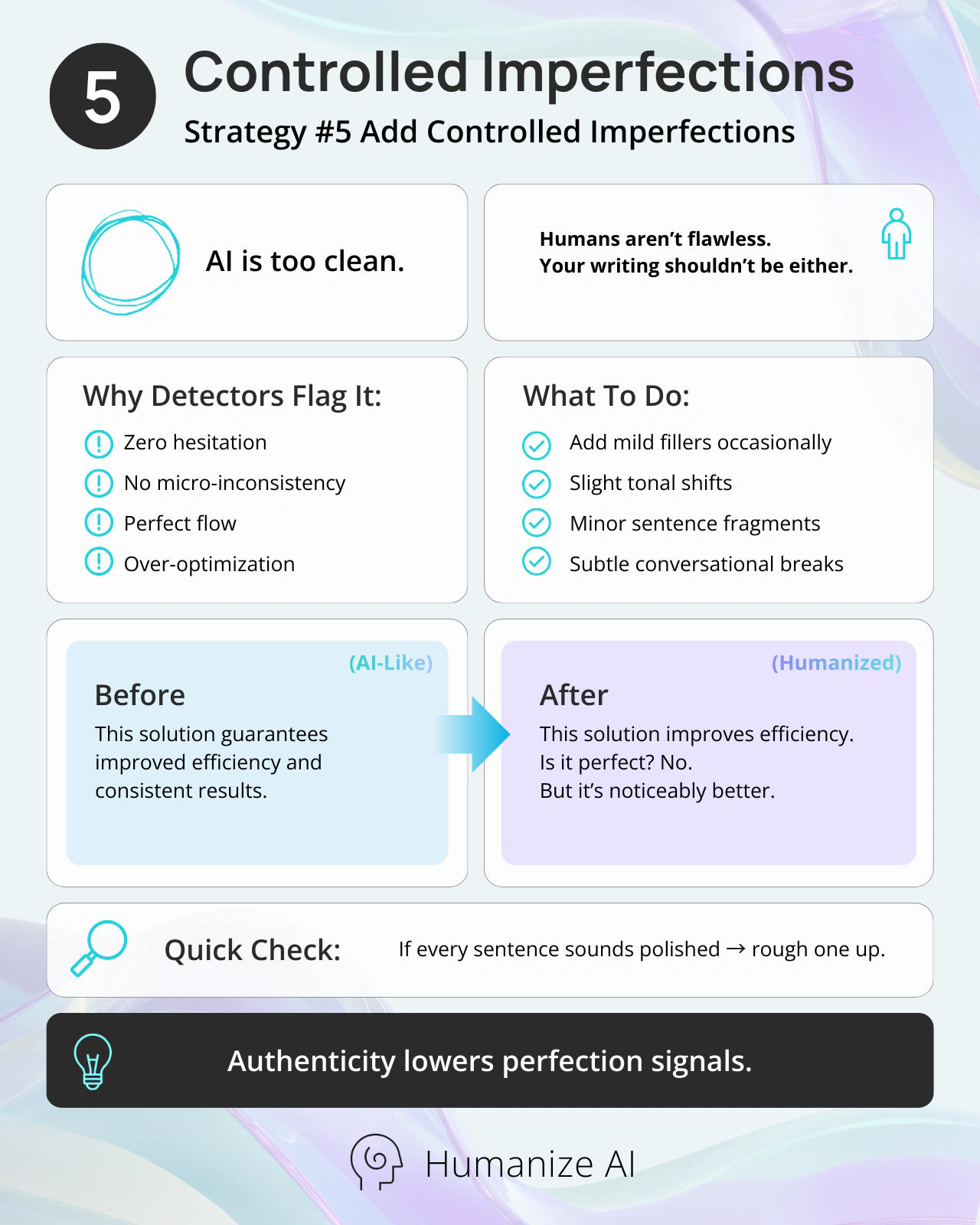
One of the fastest ways AI detectors flag text is when it looks too clean. Perfect grammar, perfectly balanced sentences, and flawless pacing are not how most people write outside of edited publications. Detection systems treat that level of consistency as a signal, not a strength.
Controlled imperfections help because they introduce human irregularity, which is hard for models to simulate reliably. This does not mean adding mistakes randomly. It means allowing the kind of minor deviations real writers make when they are explaining, reflecting, or thinking through an idea.
Why Slight Imperfection Looks More Human
Human writing often includes small friction points. A sentence might run slightly long. Another might be abrupt. Grammar is correct overall, but not mechanically perfect. AI-generated text, by contrast, tends to optimise for correctness at every step, which creates smoothness that is statistically noticeable.
Detection systems measure this smoothness. When pacing stays even and grammar never bends, the text becomes predictable. Introducing small variations breaks that predictability without damaging clarity.
What “Controlled” Actually Means
Controlled imperfections are subtle and intentional. They should never reduce understanding or professionalism.
Examples include:
- Light filler words such as “actually,” “kind of,” “honestly,” or “in practice” when they fit the tone
- Occasional sentence fragments used for emphasis
- Slightly uneven paragraph pacing instead of uniform sentence lengths
- Natural repetition where a human would reinforce a point instead of replacing it with a synonym
These elements mirror how people explain things in real conversations and drafts.
How This Helps Avoid AI Detection
If you are applying tips to avoid AI detection in writing, this step matters because it targets behaviour, not vocabulary. Controlled imperfections increase entropy in the text. They make sentence flow less uniform and reduce the statistical signals detectors rely on.
The key is restraint. Overdoing imperfections looks sloppy and can hurt credibility. Used carefully, they restore human rhythm and reduce AI-likeness without rewriting everything from scratch.
This is not about lowering quality. It is about allowing the text to behave like it was written by a person, not optimised by a system.
6. Use Advanced Rewriting Plus Manual Editing
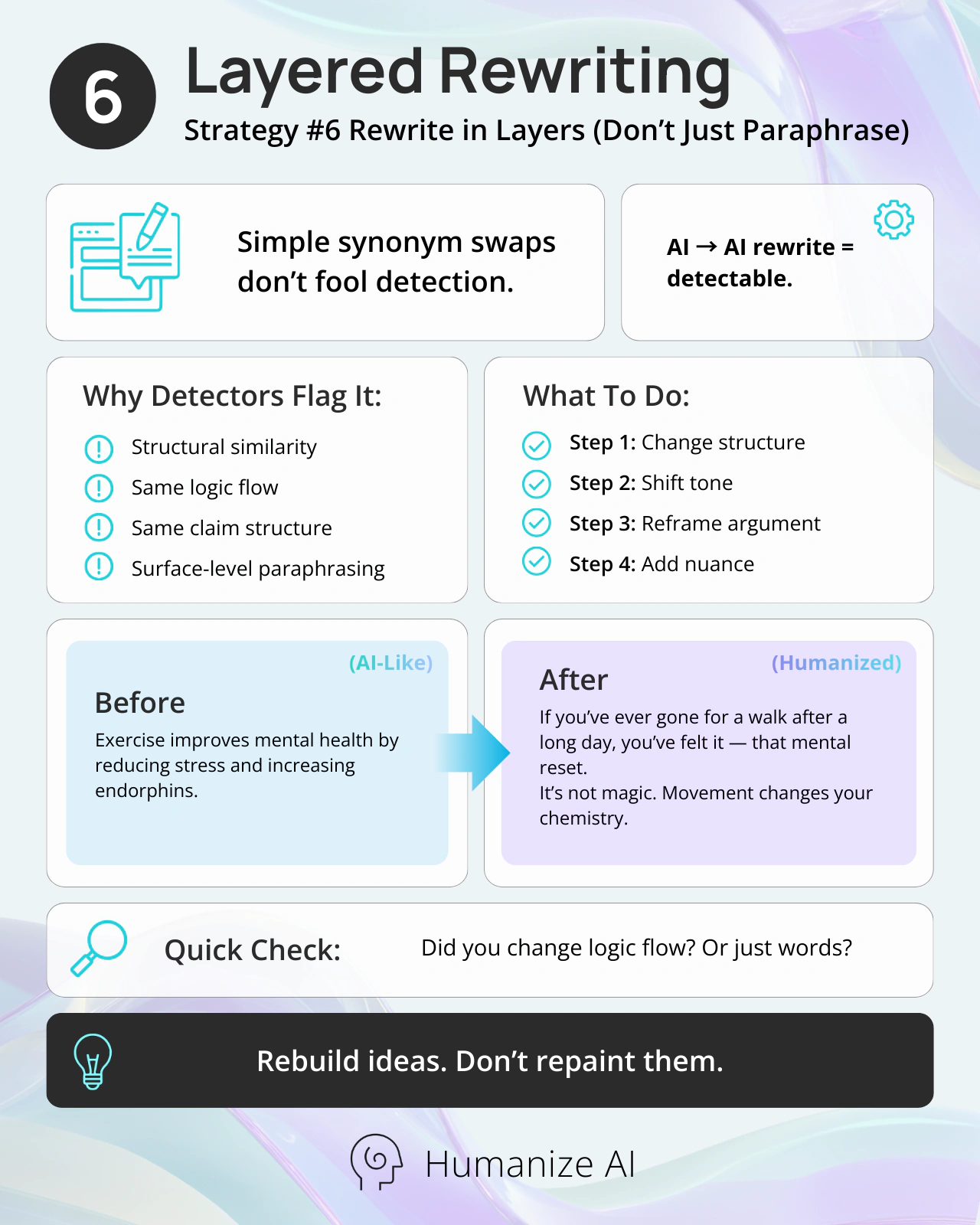
Relying on a single step rarely works. If your goal is to reduce detection risk in a realistic way, the most reliable approach is a layered workflow. That means starting with AI, rewriting strategically, and then applying deliberate human edits where detectors are most sensitive.
Why a One-Step Rewrite Fails
AI-generated drafts tend to carry the same structural fingerprints, even after paraphrasing. Many rewriting tools focus on swapping words or smoothing grammar. That helps readability, but it does not change the deeper patterns detection systems measure. When text moves directly from AI output to publication, those patterns remain intact.
A layered process breaks that chain.
The Practical Workflow That Holds Up
A proven structure looks like this:
1. AI generation
Use AI to create a rough draft or outline. Treat this as raw material, not a finished product.
2. Advanced rewriting (optional tools)
Tools such as GPTinf, HumanizeAI, or UndetectableAI can help restructure sentences, vary rhythm, and reduce obvious model patterns. At this stage, the goal is structural change, not polish.
3. Manual human editing
This is the non-negotiable step. Human review is where detection risk drops the most.
What Must Always Be Human-Edited
Some parts of a text consistently trigger AI flags and should never be left fully automated:
Openings
Introductions often sound generic when written by AI. Rewrite them to include context, framing, or intent that reflects how a human would begin.
Transitions
AI relies heavily on predictable connectors. Adjust transitions so they reflect reasoning rather than formula.
Examples and explanations
Replace abstract examples with specific, situational ones. Personal or real-world framing adds unpredictability that tools struggle to replicate.
Conclusions
AI conclusions often summarise mechanically. Human editing should refine emphasis and adjust tone based on what actually matters.
Why This Approach Works
Detection systems look for consistency across a document. A layered workflow introduces controlled disruption at multiple levels: wording, structure, pacing, and context. Each pass weakens the statistical signals detectors rely on.
If you are applying tips to avoid AI detection in writing, this step matters because it accepts a hard truth. No tool replaces judgment. Advanced rewriting helps, but manual editing is what turns an AI-assisted draft into text that behaves like it was written by a person.
Used together, this approach reduces false positives, preserves meaning, and avoids the endless cycle of rewriting after every scan.
7. Optimize for Semantic Depth, Not Surface-Level Rewrites
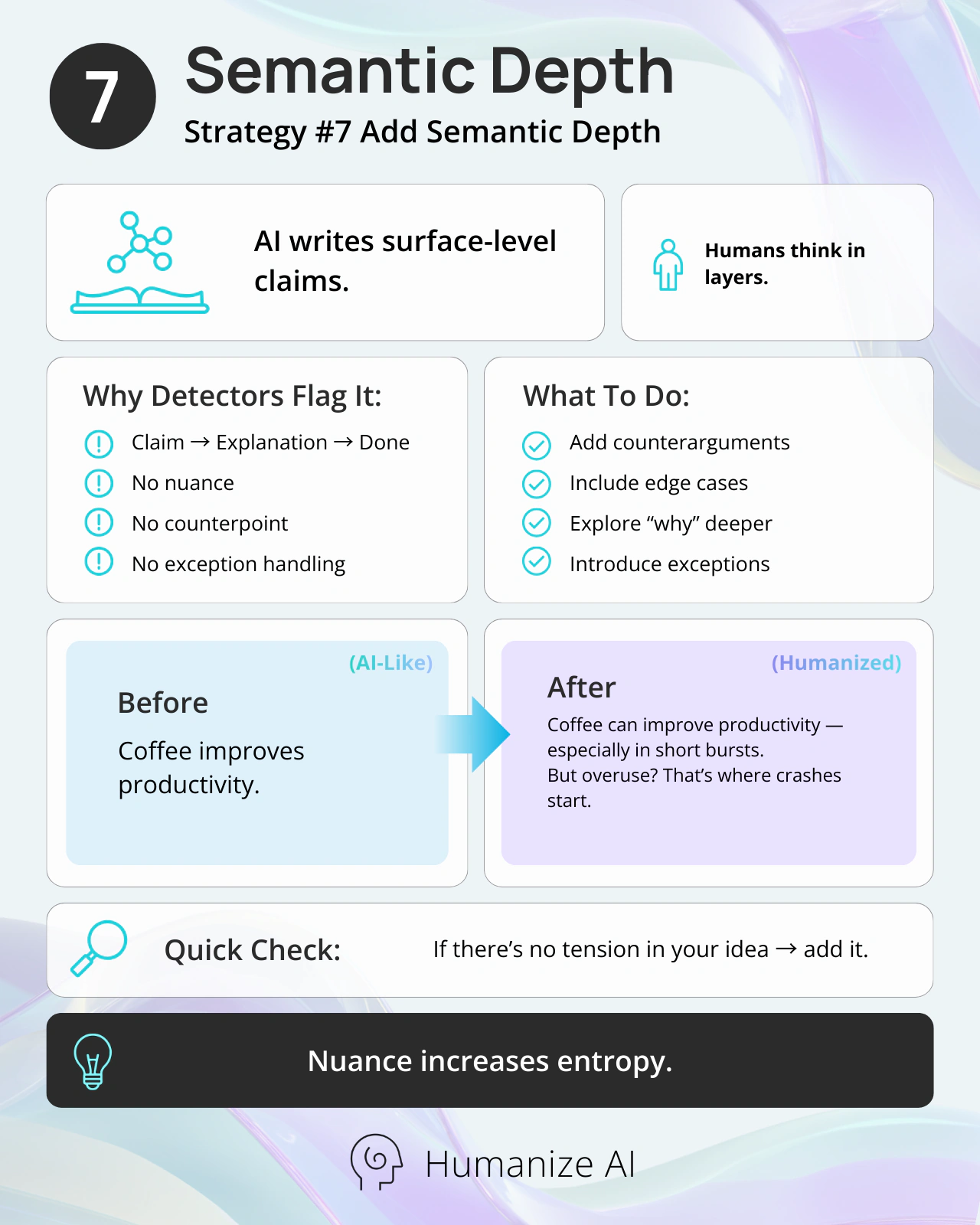
Surface rewrites fail because they change how text sounds, not how it thinks. AI detectors increasingly reward depth of reasoning and penalize shallow restatements. When a passage repeats ideas with minor wording changes, it stays predictable. That predictability is what detection systems score.
What Semantic Depth Actually Means
Semantic depth shows up when a paragraph does more than restate a point. It explains why something happens, how it works in practice, and what changes under different conditions. Human writers tend to layer ideas. They clarify assumptions, add constraints, and connect causes to outcomes. AI drafts often stop at explanation level one.
Depth is not length. It is structure.
Examples of depth signals detectors read as human:
- A claim followed by reasoning, then a limitation
- A general rule followed by a conditional exception
- An explanation that anticipates a reader’s doubt and addresses it
Why Detectors Read Depth as Human
Detection systems analyse coherence across sentences, not just within them. When text develops ideas across multiple layers, sentence behaviour becomes less uniform. Pacing changes. Emphasis shifts. New concepts enter mid-paragraph. This raises burstiness, which lowers AI-likeness.
Shallow rewrites keep the same logic order and sentence rhythm. Even with new words, the structure stays flat. Deep edits alter how ideas unfold, which is harder for models to mimic consistently.
How to Add Depth Without Overwriting
If you want to strengthen depth while avoiding detection, focus on reasoning, not synonyms:
- Add a brief explanation of cause or consequence after key claims
- Introduce one constraint or edge case per section
- Replace generic statements with situational context
- Connect paragraphs logically instead of listing points
Shallow:
AI detectors flag predictable text because it follows patterns.
Deeper:
AI detectors flag predictable text because repeated structure lowers entropy. When pacing stays even across paragraphs, probability models assign higher AI confidence, even if the wording is clean.
The second version adds mechanism, not fluff.
Why This Matters More Than Rewriting Tools
Tools can help restructure sentences, but they cannot invent reasoning that was never there. Semantic depth comes from intent. It requires understanding what the reader needs and what the text must resolve.
If you want to reduce detection risk long term, stop chasing cosmetic rewrites. Build explanations that develop, qualify, and adapt. That is how human writing behaves, and it is where detectors struggle most.
Common Mistakes That Trigger AI Flags
Most AI detection issues do not come from using AI itself. They come from how the text is edited afterward. The mistakes below repeatedly increase detection confidence, even in human-written drafts.
Overusing Synonyms
Writers often replace words aggressively to “sound different.” This creates unnatural variation where a human would normally repeat simple terms. Detectors read this as engineered rewriting rather than organic expression.
Perfect Grammar Everywhere
Text with zero friction looks artificial at scale. Human writing usually contains minor inconsistencies in rhythm, emphasis, or structure. When every sentence is perfectly balanced, predictability rises.
Robotic or Neutral Tone
A flat, objective tone across an entire article increases AI-likeness. Humans shift tone naturally depending on explanation, emphasis, or context. AI output tends to stay emotionally level.
Repeating the Same Paragraph Pattern
Paragraphs that all start the same way, follow the same sentence order, or end with the same type of summary are easy to flag. Structural repetition matters more than word choice.
Imbalanced Perplexity and Burstiness
Text that is too smooth or too chaotic can both raise flags. Low burstiness combined with evenly paced sentences is a common AI signal. Overcorrecting by forcing randomness can also backfire.
Avoiding these mistakes reduces detection risk more effectively than repeated paraphrasing.
Conclusion
AI detection in 2025 is not about catching tools. It is about identifying patterns. Writers who focus only on wording miss the real issue. Structure, pacing, tone, and reasoning are what detection systems measure.
If your goal is to make text not AI detectable, the solution is not hiding AI use. It is writing that behaves like human writing. That means uneven rhythm, layered explanations, personal context, and intentional imperfection. This is also why platforms such as HumanizeAI.pro focus on structural and behavioural signals rather than surface-level paraphrasing.
The seven tips in this guide work because they address how detectors actually operate, not how they are marketed. Apply them consistently, review outputs manually, and treat detection scores as signals, not verdicts.
FAQs
Can I fully avoid AI detection in writing?
No method guarantees a clean result. AI detectors use probability models, not proof. The goal is to reduce risk, not chase zero scores.
Is paraphrasing enough to bypass AI detection?
No. Paraphrasing changes words, not structure. Most detection systems flag predictable sentence flow even after rewriting.
Why does human-written text sometimes get flagged as AI?
Clean, neutral, highly structured writing can look statistically similar to AI output. Lack of personal context increases false positives.
Should I rely only on AI humanizer tools?
No. Tools help with restructuring, but manual editing is still required, especially for introductions, transitions, and examples.
What matters more: vocabulary or structure?
Structure. Sentence rhythm, paragraph flow, and reasoning depth influence detection more than word choice.