
AI Detector for Teachers
Checks student text for AI and explains exactly why it was flagged
- Writing style and tone analysis
- Repetitive phrasing or structure patterns
- Vocabulary diversity and word choice
HumanizeAI.pro provides writing-quality insights for clarity, tone, and readability. It must NOT be used for academic dishonesty, plagiarism, or misleading submissions.
AI detector teachers use: free, no account required
What Is an AI Checker for Teachers?
An AI checker for teachers by Humanize AI is a free and unlimited tool that analyzes student-submitted text to determine if it was generated by an AI model such as ChatGPT, Claude, or Gemini.
The tool runs on our up-to-date custom technology to identify AI patterns and returns a reasoning panel that explains every flagged segment using specific linguistic signals: sentence length, punctuation patterns, function word density, pronoun usage, and more. The standalone detector is fully free and requires no account to use.
How the Free AI Checker for Teachers Assists You
This tool helps you check student submissions for AI-generated content before grading, review a detailed signal-level report for each flagged section, and use the findings as reliable evidence in academic integrity conversations.
Review essay submissions before grading
Running student work through the detector before grading helps you spot AI-generated content early, so your feedback reflects the student's actual effort. The tool checks the submission across 8 detection systems at once, including Turnitin, Copyleaks, GPTZero, and OriginalityAI, and returns individual pass/fail results for each alongside an overall AI probability score displayed via a gauge. You get a clear, cross-referenced result before you invest time in detailed assessment.
Identify borderline submissions
A single percentage score is not enough to act on when a paper could go either way. The tool returns a three-way segment breakdown showing exactly which parts of the text were classified as AI-generated, Mixed, or Human-written, displayed with color coding so you can locate the problem sections at a glance. The signal-level reasoning panel then shows exactly which sentences triggered the result and why, covering patterns like sentence length distribution, function word density, and punctuation variety, giving you something specific to evaluate rather than a number to guess from.
Support academic integrity conversations
When the AI detector for teachers returns a high AI probability score, the detailed reasoning breakdown gives you a concrete, signal-based record to refer to. The report explains every flagged segment using specific measurable signals: sentence length averages, mean word length, punctuation patterns, subject-pronoun distribution, function word density, and cross-sentence vocabulary reuse. Each signal is referenced against the actual sentence in the submitted text, so you can point to specific passages and the linguistic patterns behind each one, making the conversation more constructive and grounded in data rather than suspicion.
Key Features of the Teacher AI Checker
AI Humanizer
The AI Humanizer rewrites AI-generated text at the structural level, changing sentence construction, grammatical subjects, and clause order. It supports multiple rewriting modes and preserves the original meaning and register throughout.
Grammar Checker
The Grammar Checker identifies and corrects grammar, spelling, and punctuation errors in real time. It runs on a self-hosted engine, meaning submitted text does not pass through third-party servers. Errors are highlighted inline with a one-click fix option.
Plagiarism Checker
The Plagiarism Checker scans text against web sources and returns a match percentage, flags matched segments inline, and identifies source URLs alongside match percentage and segment count.
How to Use the Free AI Detector for Teachers
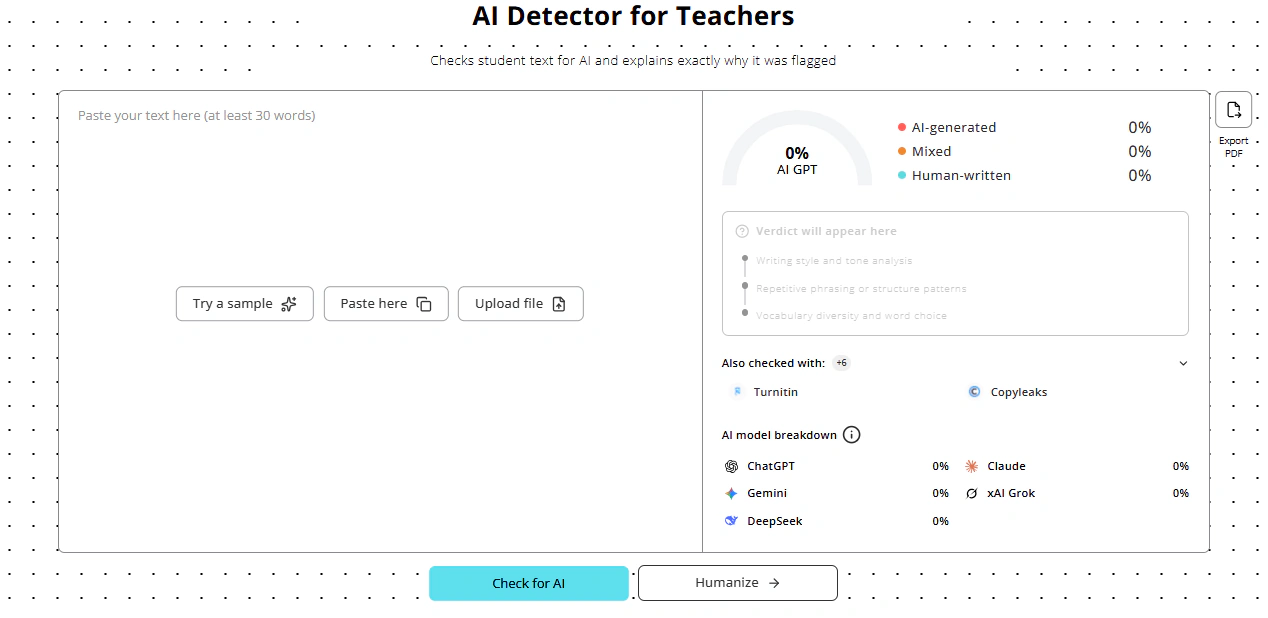
Step 1. Paste the student text
Open the AI Detector tool and paste the submission you want to check, no account is required.
Step 2. Run the detection
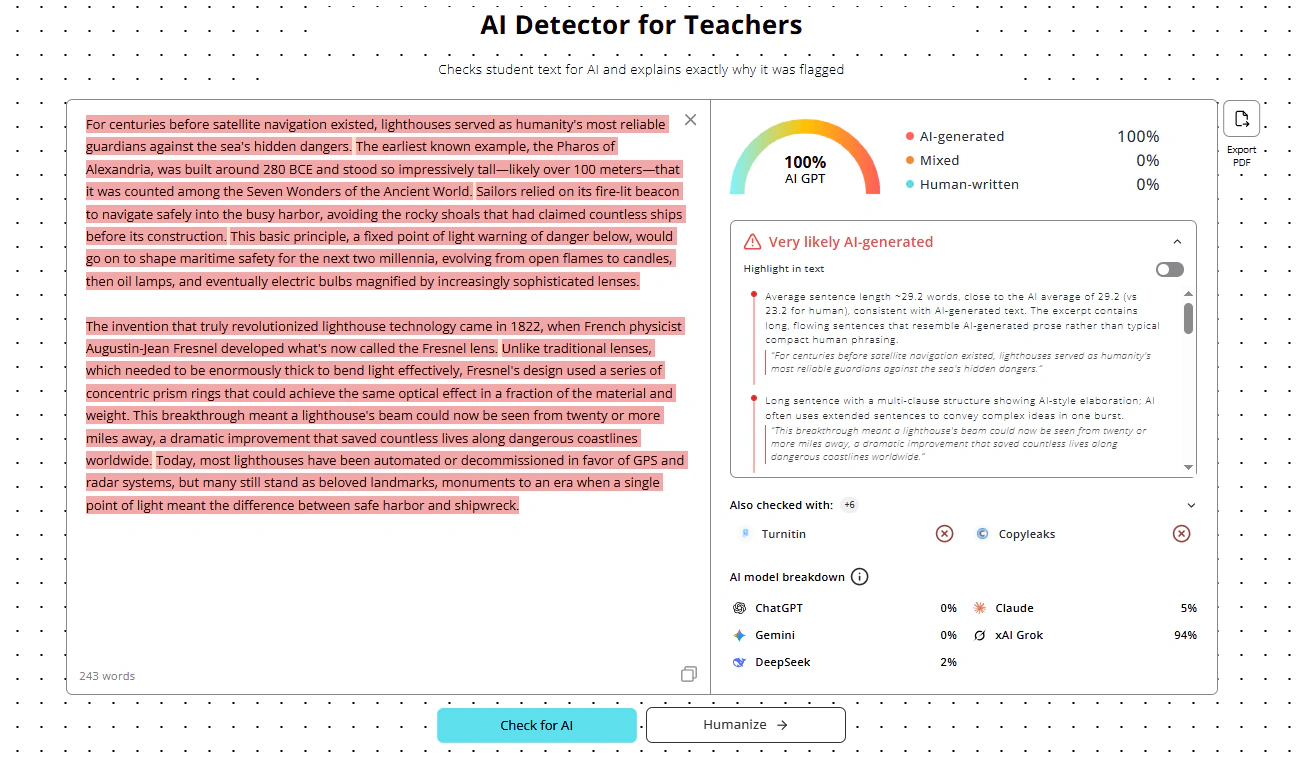
Press the ‘Check for AI’ button to start the scan. The checker runs the text against all 8 detection systems and generates the full result: overall AI probability score, per-detector pass/fail, segment breakdown, and reasoning panel.
Step 3. Review the reasoning panel
Check the per-detector results to see which systems flagged the text, then read the reasoning panel for the signal-level breakdown. Each flagged segment includes an explanation of which measurable patterns triggered the classification.
Teacher AI Detector: Common Use Cases
Teachers and professors
Teachers use this tool to check student essays, research papers, and short assignments for AI-generated content. The per-detector breakdown and signal-level reasoning panel are particularly useful when the overall score alone is not enough to act on, this is the AI checker professors use when a submission scores in a borderline range and they need to understand what specifically triggered the result before drawing any conclusions.
Academic staff reviewing borderline submissions
Academic reviewers use the reasoning panel to examine flagged text at the signal level rather than relying on a single score from a single system. Seeing that a passage was flagged because its sentence length distribution, function word density, and vocabulary patterns all fall within AI-writing norms rather than just seeing a percentage, provides a more defensible basis for review.
Students checking their own work before submission
Students use the standalone detector to run their own writing through the same systems their institution may use. Because the tool is free and requires no account, it is accessible at any point in the writing process, and the reasoning breakdown gives them specific feedback on which parts of their text read as AI-generated and why.
Final Note
This is a free AI detection tool for teachers, academic staff, and students who need more than a score when reviewing text for AI-generated content. It runs submitted text across 8 detection systems simultaneously, returns individual pass/fail results for each, and generates a signal-level reasoning breakdown for every flagged segment, explaining the specific linguistic patterns that contributed to the classification. No account is needed to use the standalone detector. The result gives you the evidence to understand what was flagged and why, before deciding what to do next.
QA
What AI detector do teachers use?
There is no single standard. Different institutions use different tools, and many teachers run text through more than one system because results can vary. This checker addresses that directly by cross-checking submitted text against 8 detection systems in one run, including Turnitin, GPTZero, Copyleaks, and OriginalityAI, so you can see the full picture without checking each tool separately.
What AI checker do teachers use to check student work?
Teachers commonly use tools like GPTZero, Turnitin's AI detection, Copyleaks, and OriginalityAI. This checker runs text against all eight of the most widely used systems simultaneously and returns individual results for each, making it useful for teachers who want a cross-referenced view rather than a single model's output.
Is the AI checker free for teachers?
Yes. The standalone detector is fully free and requires no account. You can paste student text and run a full detection, including the 8-system cross-check, overall AI probability score, segment breakdown, and reasoning panel, without signing up.
What is the best AI detector for teachers?
The best AI detector for teachers is one that gives you enough information to act on the result. A bare percentage score from a single system is hard to act on, especially for borderline submissions. This checker returns results from 8 systems, a three-way segment breakdown, and a per-sentence reasoning panel that explains each flag using specific linguistic signals, giving teachers a more complete picture before drawing conclusions.
How accurate is an AI checker for teachers?
No AI detector is 100% accurate. All systems produce some false positives and false negatives, and accuracy varies depending on the model version, text length, and how much human editing the AI-generated content has received. This checker mitigates single-model error by running text across 8 systems and showing individual results for each, rather than relying on one model's classification alone.
Does the AI checker explain why text was flagged?
Yes. The tool includes a detailed reasoning panel that explains every flagged segment using specific measurable signals, such as sentence length distribution, function word density, punctuation patterns, mean word length, and cross-sentence vocabulary reuse. Each explanation references the actual sentence from the submitted text.