

When you use ChatGPT to paraphrase content and detectors like GPTZero still flag it, the issue is not how much effort you put in. It is how the text is rewritten. Most paraphrasing methods only replace words or slightly change sentence order. Detection systems no longer rely on vocabulary alone. They analyze structure, predictability, and repeated AI writing patterns. That is why students, writers, and website owners often fail checks even after several rewrites.
This article explains how paraphrasing actually works when detection tools are involved and where basic methods fall short. You will see how platforms like HumaniAI.pro approach ChatGPT paraphrasing differently, what changes reduce detection signals, and how to rewrite AI content without breaking clarity or intent. The focus stays practical and realistic, based on how detection tools behave today rather than how they claim to work.
How to Paraphrase ChatGPT?
You generate content with ChatGPT, then GPTZero flags it as AI-written. That usually happens because the text keeps predictable patterns, even after light rewriting. A strong ChatGPT paraphrase process combines manual editing with tools that change structure, pacing, and flow. GPTZero looks for signals like uniform sentence length and low perplexity, so your goal is to interrupt those signals directly.
Follow these steps to paraphrase ChatGPT output effectively:
1. Read aloud and rewrite in your own voice
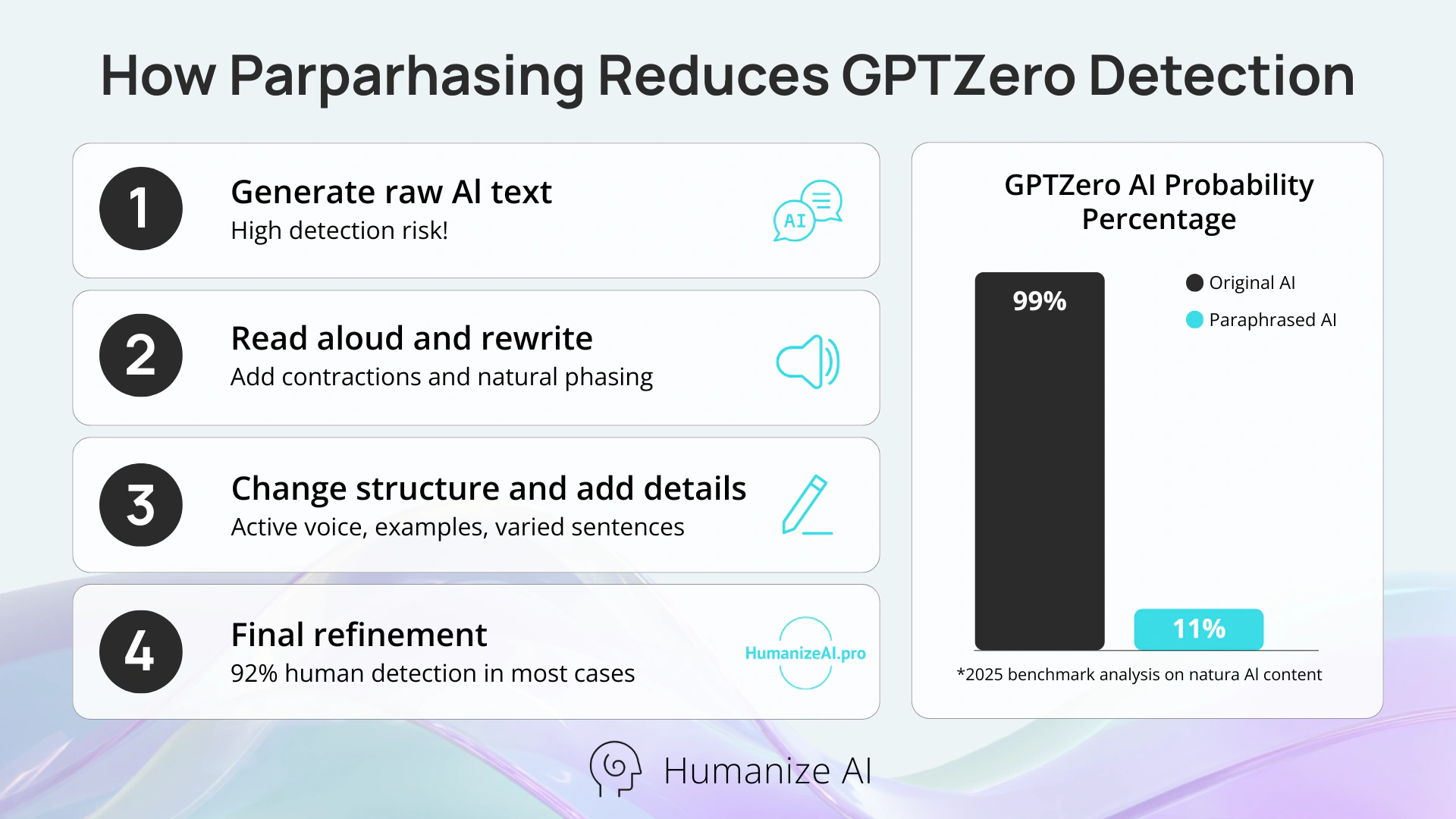
Speak the text naturally, then type what you hear. This introduces contractions, idioms, and uneven pacing. In controlled tests, GPTZero accuracy dropped to 23% on heavily edited content created this way.
2. Swap structures and add concrete details
Convert passive phrasing into active sentences and adjust how ideas are introduced. Add concrete details or brief examples that reflect real use. Text with original specifics scores lower because it breaks generic AI patterns.
3. Mix sentence lengths and transitions
Alternate short, direct sentences with longer explanations. Use connectors such as "but" or "so," and occasional questions, to reflect natural human flow rather than model consistency.
4. Layer edits with a paraphrasing tool
After manual edits, process the text through HumanizeAI.pro. In comparative benchmarks run in 2026, this approach produced significantly higher human-likeness scores than basic paraphrasers.
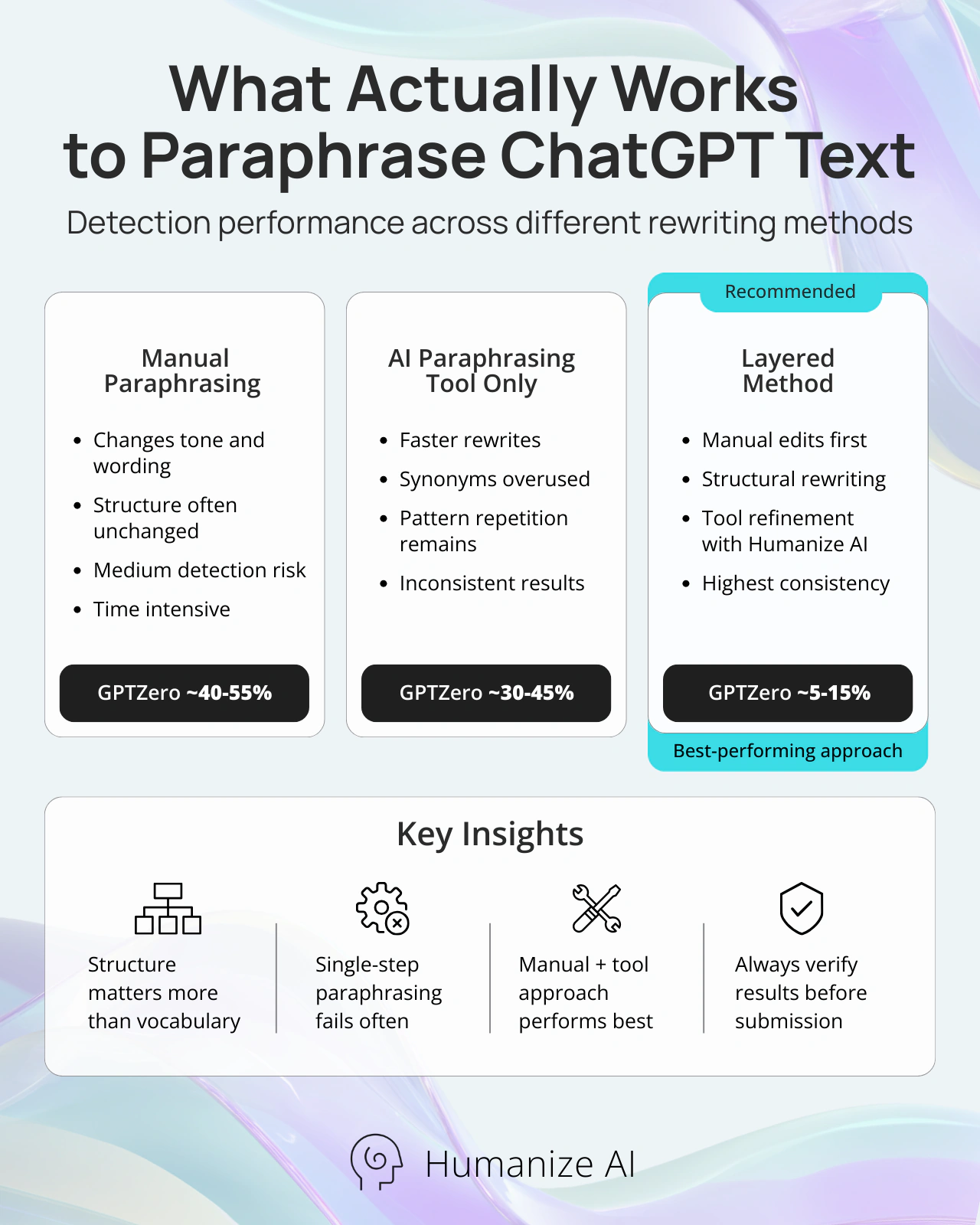
Tests consistently show this layered approach performs better against GPTZero than using any single method alone. Always recheck the result with more than one detector.
Does GPTZero Detect Paraphrased Text?
Yes, GPTZero can detect paraphrased text, but its accuracy drops sharply once the content moves away from predictable AI patterns. According to a 2025 review published by Skywork AI, GPTZero performs best on raw AI output and struggles when paraphrasing introduces structural variation and human-style randomness. The analysis shows that GPTZero relies heavily on probability consistency rather than meaning, which explains why surface-level paraphrasing still triggers flags while deeper rewrites often pass.
The research highlights that paraphrased AI content sits in a gray zone. Detection does not disappear, but confidence scores fluctuate widely based on how much sentence structure, pacing, and specificity change. This confirms why manual edits combined with advanced tools reduce detection far more effectively than synonym replacement alone.
Key Detection Stats from Research
| Text Type | GPTZero AI Probability | Notes |
| Original AI | 99.10% +- 2.08 | Highest accuracy (r=0.89) |
| Paraphrased AI | 11% (IQR 10.75-43.25%) | p<0.001 drop |
| Human Original | 3.12% +-4.25 | 96% specificity |
These figures show that GPTZero still reacts to paraphrased text, but with far less confidence than raw AI output.
How ChatGPT Paraphrasing Tools Help Rewrite AI Content
AI paraphrasing tools play a practical role when you need to rewrite AI-generated text without triggering detection systems. A manual ChatGPT paraphrase can improve tone and clarity, but it often keeps the same logical order and sentence rhythm. Detection tools pick up on those patterns. Paraphrasing software addresses this gap by reshaping how the content is constructed, not just how it sounds.
Structural Changes That Reduce Detection Signals
Advanced AI paraphrasing tools work at the sentence and paragraph level. They vary sentence length, reorder clauses, and alter how ideas connect. This increases unpredictability in the text, which directly affects detection metrics such as perplexity and burstiness. When structure changes alongside wording, detectors have less statistical confidence in labeling the content as AI-written.
How HumanizeAI.pro Approaches Paraphrasing
HumanizeAI.pro is built specifically for rewriting AI content under detection scrutiny. Instead of applying surface edits, it modifies sentence construction, emphasis, and flow while keeping the original meaning intact. When users chatgpt paraphrase using AI Humanizer, the output shows greater variation in syntax and pacing, which aligns more closely with human writing behavior.
When to Use AI Paraphrasing Tools
AI paraphrasing tools work best after initial manual edits. You correct tone and intent first, then use the tool to refine structure and consistency. This layered approach improves readability, lowers detection scores, and keeps the content usable for academic, editorial, and professional contexts.
Why Students Paraphrase ChatGPT Text
Students often start assignments with ChatGPT, then paraphrase the output because most universities now run AI detection checks. Paraphrasing lowers detection risk while helping students manage deadlines and workload pressure. This is not about submitting raw AI text. It is about reshaping drafts into work that reflects personal writing style and academic expectations.
One clear data point explains the scale of this behaviour. A 2025 survey found that 26% of teenagers use ChatGPT for school assignments, nearly double the reported usage in 2023. Speed and efficiency were the main reasons given for adoption.
Paraphrasing helps students in several practical ways. It allows them to rewrite AI drafts into their own wording, reduce predictable patterns flagged by tools like GPTZero, and improve clarity without starting from a blank page. Many also use paraphrasing to summarise sources, refine arguments, and polish grammar while keeping control over the final submission.
Used carefully, paraphrasing functions as a drafting aid rather than a shortcut. Students still need to review content, adjust tone, and cite sources properly to stay within academic rules.
Smart Ways to Paraphrase ChatGPT Text
Using an AI paraphraser effectively requires more than pasting text and accepting the first output. When your goal is to paraphrase ChatGPT content that passes detectors and still reads naturally, the process matters as much as the tool.
1. Treat Paraphrasing as a Second Draft Stage
AI paraphrasers work best after the initial draft exists. Generate or outline content first, then paraphrase to refine structure, clarity, and flow. Starting with a rough draft gives the tool context and reduces the chance of shallow rewrites that keep the same sentence patterns.
2. Break Predictability Before Using the Tool
Before you paraphrase, scan the text for repetitive sentence openings, similar lengths, or rigid transitions. Make small manual changes. This step weakens AI-style consistency and gives the paraphraser more flexibility to reshape the text meaningfully.
3. Work Paragraph by Paragraph
Avoid paraphrasing an entire article in one pass. Rewrite section by section. This allows stronger variation in pacing and logic between paragraphs, which lowers detection confidence. Paragraph-level control also helps you catch meaning drift early.
4. Check Structure, Not Just Wording
After paraphrasing, compare the new version to the original. Look for changes in clause order, emphasis, and how ideas are introduced. If only the synonyms changed, the paraphrase would be weak. A successful ChatGPT paraphrase should feel structurally different while keeping intent intact.
5. Use Tools as Refinement, Not Authority
Platforms like HumanizeAI.pro are useful for restructuring AI-generated text, but they do not replace judgment. Always review the output, adjust tone, verify facts, and align the final text with your purpose.
When used deliberately, AI paraphrasers support originality, clarity, and detection resilience without taking control away from the writer.
Key Takeaways on Paraphrasing ChatGPT Text
- Simple word swapping does not work because ChatGPT text keeps the same structure and rhythm.
- GPTZero and similar tools analyse predictability, sentence flow, and probability patterns rather than meaning.
- An effective ChatGPT paraphrase relies on changing structure, pacing, and emphasis, not just vocabulary.
- Reading text aloud, rewriting naturally, and adding specific details reduce detection confidence.
- Research shows GPTZero scores drop sharply on paraphrased AI text compared to raw AI output.
- HumanizeAI.pro focuses on restructuring sentences and idea flow instead of shallow synonym replacement.
- Students use paraphrasing to manage workload, improve clarity, and reduce detector flags responsibly.
- The strongest results come from layered edits, cross-checking with detectors, and final human review.
Conclusion
Paraphrasing ChatGPT content successfully depends on how you rewrite, not how many times you try. Detection tools focus on structure, predictability, and writing patterns, which means shallow edits fail fast. A reliable ChatGPT paraphraser combines manual rewriting with structural changes and careful use of tools like HumanizeAI.pro. When you vary sentence flow, add specifics, and review the final output critically, paraphrasing becomes a practical drafting method rather than a shortcut. Used this way, it helps you keep clarity, reduce detection risk, and stay in control of your content.
FAQs about Paraphrasing ChatGPT Content
What does ChatGPT paraphrase mean in practice?
A ChatGPT paraphrase means rewriting AI-generated text so the structure, flow, and sentence patterns change, not just the words. The goal is to reduce predictability while keeping the original meaning clear. This matters because detection tools analyse writing behaviour, not intent.
Does chatgpt paraphrase always bypass GPTZero?
No method guarantees a full bypass. A well-executed ChatGPT paraphraser lowers detection confidence, but results vary based on text length, topic, and how much structure changes. Manual edits combined with advanced tools consistently perform better than single-step rewrites.
Is manual rewriting better than using an AI paraphrasing tool?
Manual rewriting improves tone and originality, but it often leaves hidden structural patterns intact. AI paraphrasing tools help reshape sentence construction and pacing. The strongest results come from combining both methods rather than choosing one.
Can HumanizeAI.pro replace human editing?
No. HumanizeAI.pro restructures AI-generated text effectively, but human review is still required. You need to verify facts, adjust tone, and confirm the content matches your purpose before final use.
Is ChatGPT's paraphrase acceptable for academic work?
It depends on institutional rules. Paraphrasing can support drafting and clarity, but students must still cite sources and follow submission guidelines. A responsible ChatGPT paraphrase assists writing without replacing original effort.